
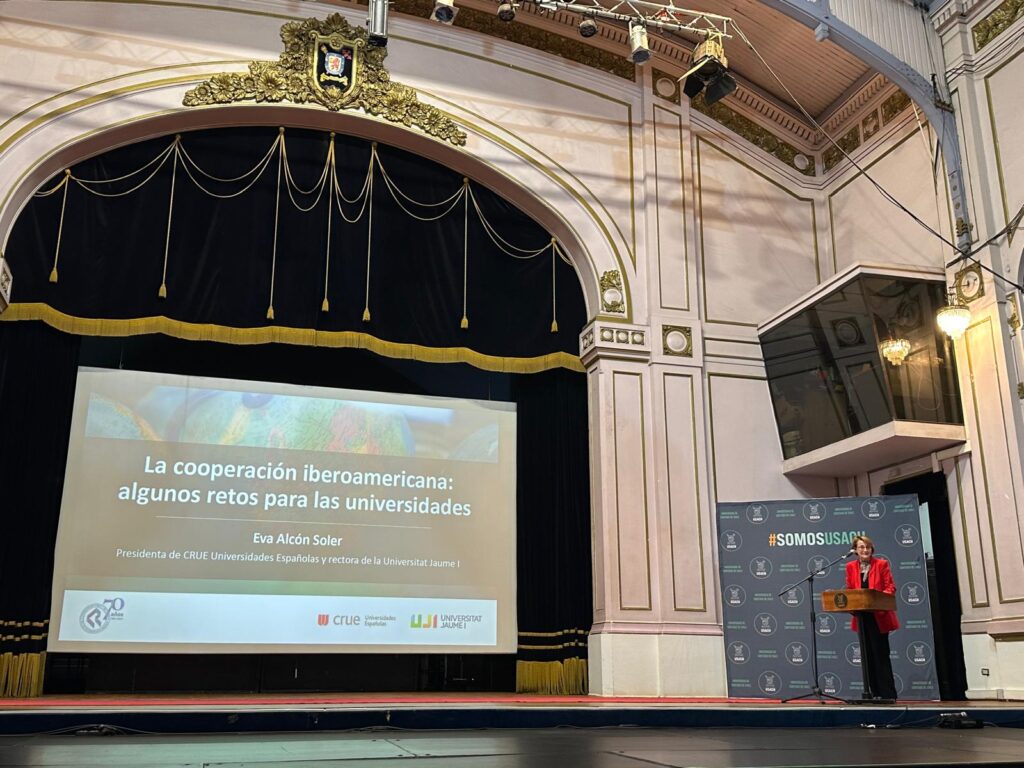
Santiago de Chile, 23 April 2025. Eva Alcón, President of the Conference of Rectors of Spanish Universities (CRUE) and Rector of Universitat Jaume I, delivered yesterday the keynote address at the official opening of the 2025 academic year of the University of Santiago de Chile (USACH). Entitled “Ibero-American Cooperation: Some Challenges for Universities”, her lecture took place within the framework of the Chile–Spain Summit of Rectors, held on 21 and 22 April in Santiago de Chile.
Held under the theme “Challenges for Universities in the 21st Century”, the meeting served as a forum for bilateral dialogue aimed at advancing the design of an Academic Cooperation Agenda between the higher education institutions affiliated with CRUE and the Council of Rectors of Chilean Universities (CRUCH). Through five thematic sessions, rectors shared experiences, challenges and proposals to address the main issues facing higher education today, from a perspective of social responsibility and institutional cooperation.
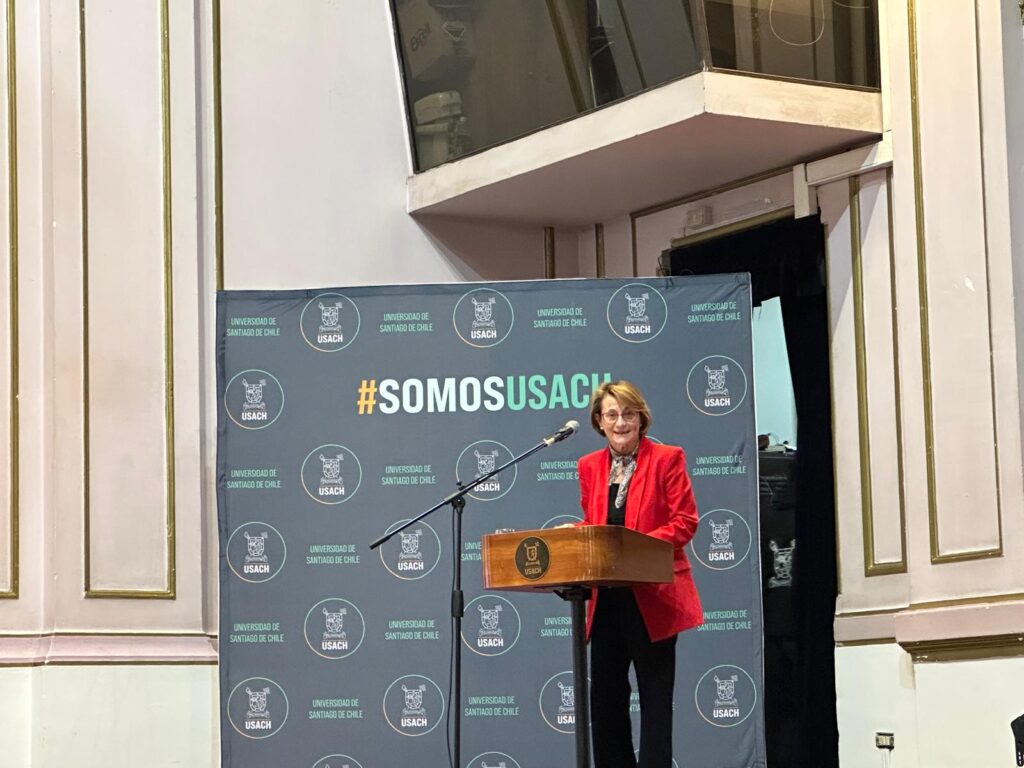
In her keynote lecture, Eva Alcón reaffirmed the key role of universities in building fairer, more sustainable and more inclusive societies. “Ibero-American cooperation is not an option, but a strategic necessity for a more equitable, innovative and socially committed higher education system,” she stated. She also highlighted the importance of promoting lifelong learning, the production of high-quality knowledge and its transfer to society as a whole, as essential elements of the university’s social mission.
“The Ibero-American university system has a historic opportunity today: to weave a vibrant academic community, open to dialogue, shared knowledge and the global challenges of our time,” added the President of CRUE, in a message that called for shared responsibility among institutions to build a common and transformative agenda.
CRUE and CRUCH Sign a Joint Institutional Declaration
In this context, CRUE and CRUCH signed a joint institutional declaration that establishes a renewed roadmap for academic cooperation between both countries. The document commits to the construction of a common knowledge area, based on principles such as reciprocity, diversity, university autonomy and social responsibility. Among its most significant commitments are the mutual recognition of degrees, the facilitation of academic mobility, the promotion of open science, and the cross-cutting integration of sustainability and artificial intelligence into joint projects.
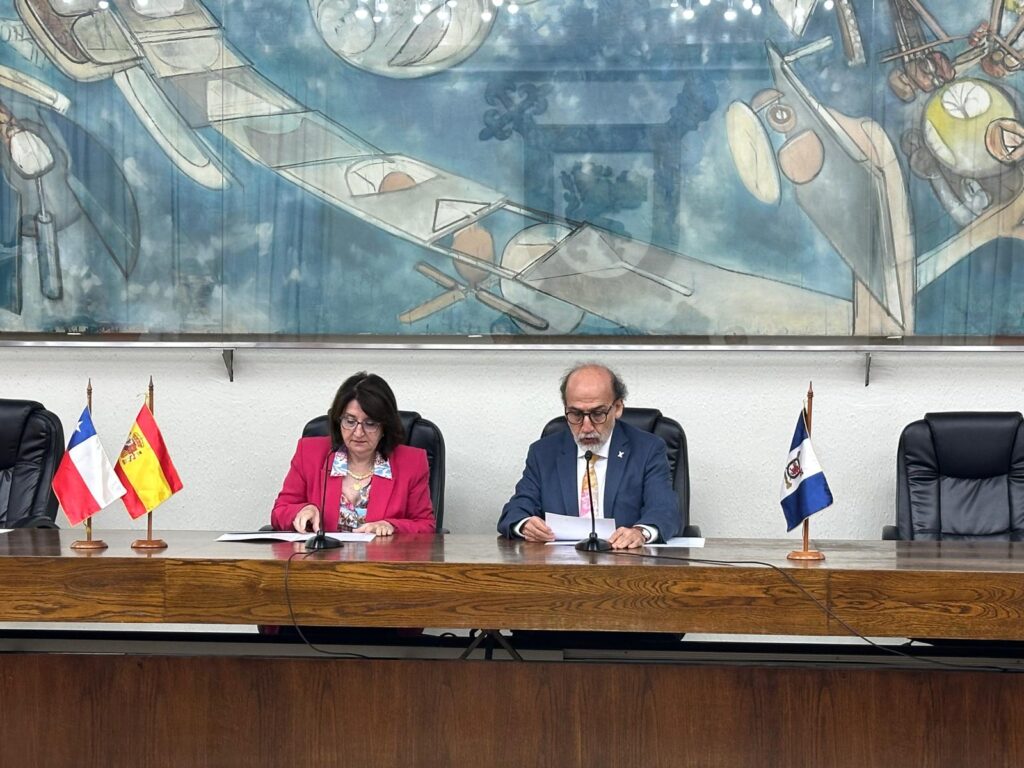
The declaration also underscores the defence of university autonomy as a guarantee of academic freedom, critical thinking and democratic participation, recognising the irreplaceable role of universities in civic education, the defence of human rights and social transformation.
The summit of rectors held in Chile marked a milestone in consolidating alliances between higher education systems across Ibero-America.
