
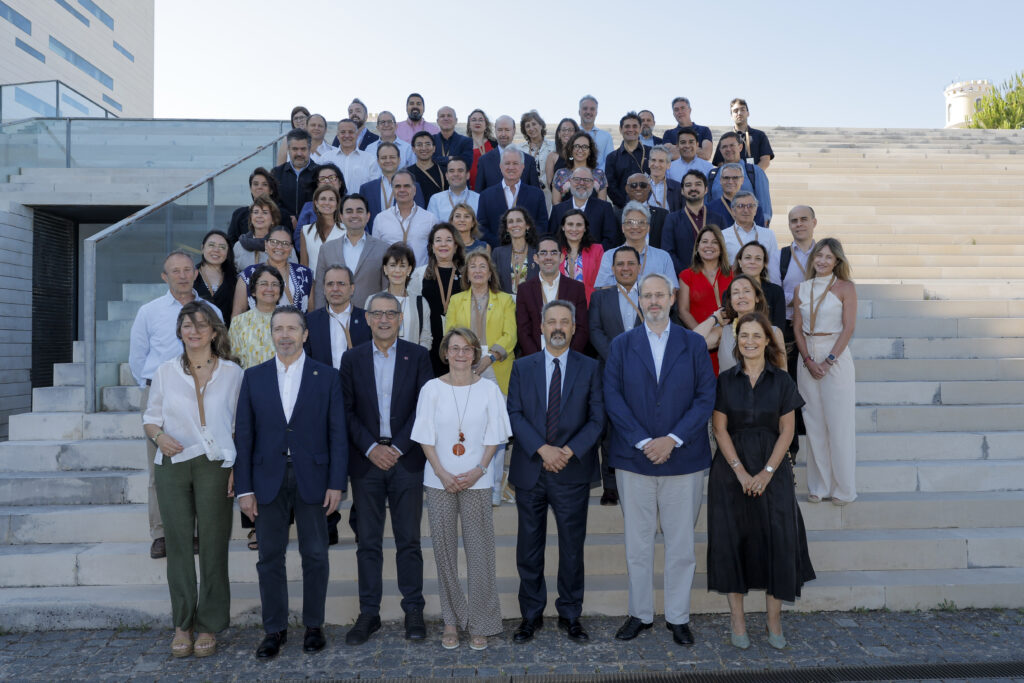
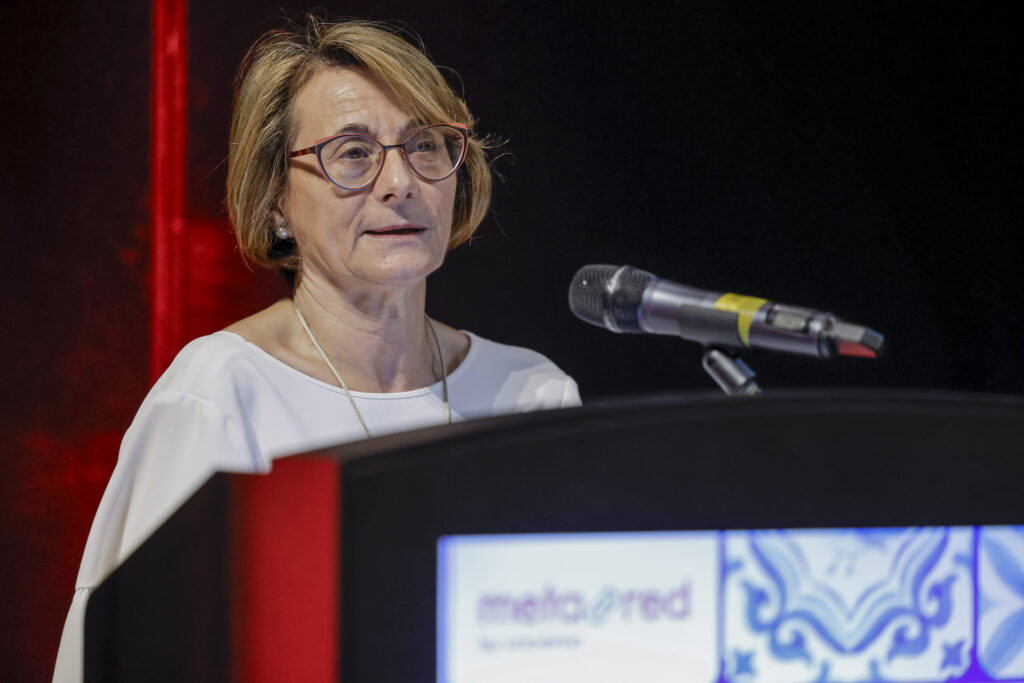
Lisbon, 26 June 2025. Eva Alcón, President of the Conference of Rectors of Spanish Universities (CRUE) and Rector of Universitat Jaume I, called on universities to lead the major challenges of the Ibero-American Knowledge Area with ethical commitment and a transformative vision. She did so on Tuesday during the international conference she delivered within the framework of the Meeting of Presidents and Rectors of MetaRed, held on 26 and 27 June at Universidade Nova de Lisboa.
Under the title “The Challenges of Higher Education in the Ibero-American Knowledge Area”, Alcón reaffirmed the role of universities as drivers of social, economic and cultural transformation. “Universities must be active agents in building fairer, more sustainable and more resilient societies,” she stated, stressing that “the university cannot merely reflect change; it must anticipate it and lead it with an ethical vision and collective commitment”.
Innovation, Employability and Inclusion: Pillars of the University of the Future
Among the main challenges, Alcón pointed to digitalisation, which “is not only a technological issue, but fundamentally a cultural and strategic one”, and in particular to “the ethical and responsible use of artificial intelligence”. In this regard, she referred to initiatives such as the CRUE report Generative Artificial Intelligence in University Teaching, as well as other actions including the Micro-credentials Plan, the Artificial Intelligence Chairs Programme (ENIA), and the AI Training Vouchers promoted by the Government of Spain.
In terms of internationalisation, the President of CRUE acknowledged the importance of working through institutional networks and highlighted the value of programmes such as Erasmus+, the European Higher Education Area (EHEA), the European Research Area (ERA), the European Universities alliances and Horizon Europe. In the Ibero-American context, she underlined its cultural and linguistic richness as “a collective asset that offers significant opportunities to develop innovative approaches to education and research”, while also warning of the structural inequalities that hinder fully equitable academic cooperation.
Alcón also advocated for “more inclusive, flexible and innovative academic mobility models that combine physical mobility with virtual or hybrid formats and multiply opportunities for students across Ibero-America”. She further called for strengthening institutional alliances to build an inclusive Ibero-American Knowledge Area with shared quality standards. In this regard, she highlighted the importance of the Ibero-American System for Quality Assurance in Higher Education (SIACES) and its coordination with the European Association for Quality Assurance in Higher Education (ENQA).
Finally, Alcón stressed the need to adapt academic provision through lifelong learning and micro-credentials that respond to new professional profiles and the evolving labour market. She also pointed to the importance of addressing “mismatches between students’ preferences and the demands of the productive environment” and of strengthening employability from an ethical perspective. In this context, she highlighted the use of impact assessment tools such as the QS Graduate Employability Rankings.
The Meeting of Presidents and Rectors of MetaRed was opened by João Sàágua, Rector of Universidade Nova de Lisboa; Ines Rocha de Gouveia, Director of Santander Universidades in Portugal; and Rafael Hernández Maestro, Director of Universia Holding. The event brings together representatives of higher education institutions from across Ibero-America with the aim of promoting university cooperation, digital development and a shared agenda based on equity, innovation and sustainability.
