
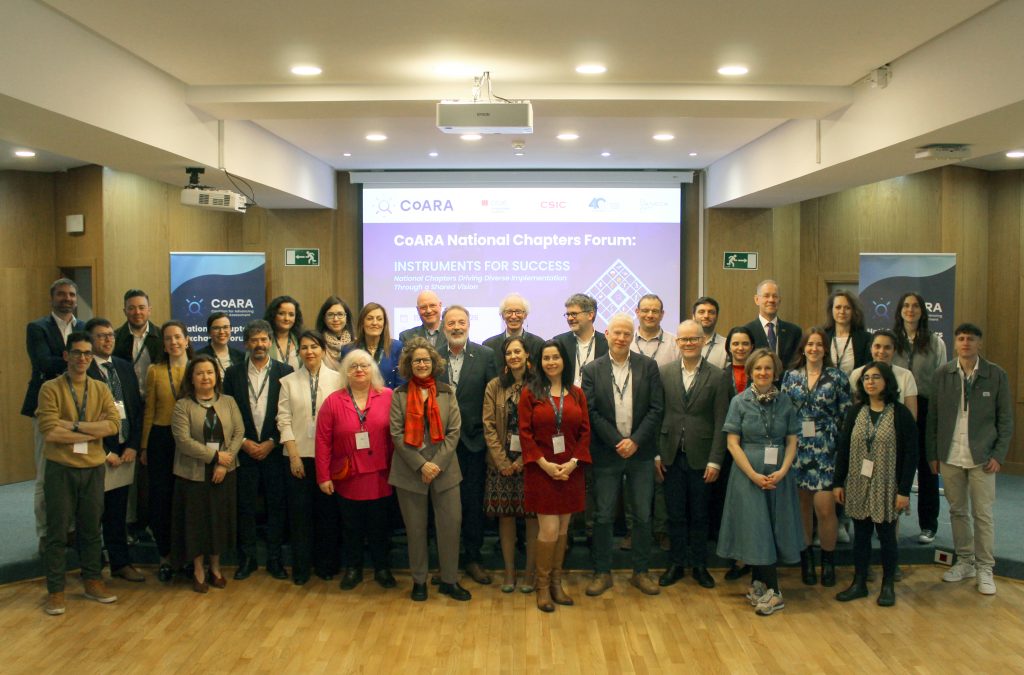
Madrid, 20 March 2026. On 19 and 20 March, Madrid hosted the 3rd Hybrid National Chapters Forum of the Coalition for Advancing Research Assessment (CoARA). The event brought together institutional representatives and international experts to discuss instruments and strategies to advance research assessment reform.
The forum, jointly organised by the Conference of Rectors of Spanish Universities (CRUE), the Spanish National Research Council (CSIC), the Carlos III Health Institute (ISCIII) and the National Agency for Quality Assessment and Accreditation of Spain (ANECA), was held under the theme “Instruments for Success: National Chapters Driving Diverse Implementation Through a Shared Vision”, focusing on the exchange of experiences and tools to facilitate the implementation of new research assessment models at national and regional level.
Spain as a Reference Point
CoARA National Chapters are national-level structures designed to collaborate and advance, building on each country’s experience, in implementing the coalition’s commitments and supporting efforts to reform research assessment internationally.
The Spanish National Chapter, launched in February 2024, is driven by CRUE, CSIC, ISCIII and ANECA. Currently, more than 90 Spanish institutions are involved in this initiative, including quality assurance agencies, research centres, universities and scientific organisations, with the aim of developing new assessment processes that recognise the diversity of research outputs, practices and career paths.
In addition to coordinating the CoARA National Chapter in Spain, the four institutions have developed specific actions to promote these processes at national level.
CSIC, which joined the CoARA Agreement in November 2022, established the CoARA–CSIC Commission to develop an institutional analysis enabling the design of a flexible and multidimensional assessment model adapted to the diversity of scientific activity. This work is part of the CSIC CoARA Action Plan 2023–2027.
ANECA has reformed its academic staff and programme evaluation procedures to incorporate new qualitative criteria in line with CoARA principles. Earlier this month, it presented a proposal for pilot experiments on qualitative academic assessment, selected by CoARA for funding under Horizon Europe.
CRUE has also actively contributed to these processes through its role as technical secretariat of the CoARA National Chapter in Spain, supporting coordination among institutions and monitoring initiatives developed within this framework. Among other actions, it has facilitated engagement with CoARA and other European forums to ensure visibility and coherence in the participation of the Spanish university system in research assessment reform.
Finally, ISCIII, as a national funding agency managing the Strategic Action in Health and accrediting R&D&I structures in the health sector, has progressively integrated principles of open science and research assessment reform. To this end, it has adapted the evaluation criteria of its calls, incorporating metrics focused on social impact and developing training tools to support their proper implementation.
Consolidating Research Assessment Reform
During the two working sessions of this 3rd Forum, participants analysed progress in implementing CoARA reform in their respective countries, with particular attention to the instruments, regulatory frameworks and tools enabling its development. Activities included strategic sessions, exchange spaces between national chapters and thematic presentations, fostering an open dialogue on the future role of these structures within the coalition.
Participants highlighted the importance of promoting more qualitative, responsible and inclusive assessment models, aligned with open science principles and a broader understanding of scientific and societal impact. They also stressed the need to adapt reform tools and frameworks to different national systems, while maintaining a shared European vision.
